

第一部分 听力测试 (共30分)
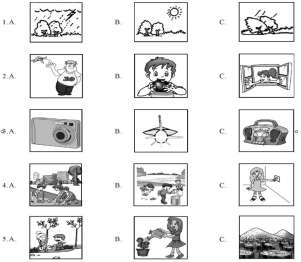
一、听对话选图 (每小题1分,共5分)
二、对话理解 (每小题1.5分,共15分)
6. What is Susanna interested in?
A. China’s history. B. The geography of China.
C. China’s literature.
7. Which dynasty was Zheng He from?
A. The Yuan Dynasty. B. The Ming Dynasty.
C. The Qing Dynasty.
8. How long did his ocean journeys last?
A. 26 years. B. Nearly 28 years. C. Half a century.
9. What is Jane’s favorite food?
A. Potato salad. B. Fried chicken. C. Fish and chips.
10.What should we do to prevent the bird-flu according to the dialogue?
A. We shouldn’t eat chicken any more.
B. The chickens should be killed at once.
C. Don’t eat the chicken which is not cooked well.
11.Which kind of drink will they have?
A. Apple juice. B. Some beer. C. Two cups of coffee.
12. What is Michael going to do?
A. Go camping. B. Visit his uncle. C. Do some shopping.
13. When is he leaving?
A. In a week. B. Maybe at the end of July.
C. Maybe at the end of June.
14. Where is he going to visit?
A. Some places of interest. B. Maybe the museum. C. One of the national parks.
15. Why isn’t he going to buy a tent?
A. Because he has one.
B. Because it’s too expensive. C. Because he needn’t.
三、短文理解 (每小题2分,共10分)
16. Where is the popular saying from?
A. China. B. India. C. America.
17. What’s the most popular way to relax ourselves according to the passage?
A. Some sports. B. Enough sleep. C. Watching TV.
18. Which sport isn’t mentioned in the passage?
A. Skating. B. Cycling. C. Climbing mountains.
19. How many team sports can you hear?
A. One. B. Two. C. Three.
20. What can we learn from the passage?
A. We only need to enjoy some entertainments.
B. We need more indoor activities.
C. We need to rest as we need to work.
第二部分 笔试部分 (共90分)
四、单项填空 (每小题1分,共15分)
21. Maria would like orange, not orange juice.
A. a; the B. /; an C. an; / D. an; an
22. Chinese President Xi Jinping and his wife Peng Liyuan set off on their first state visit to Russia
March 22, 2013.
A. in B. on C. by D. at
23. —Mother’s Day is celebrated across the world on the Sunday in May.
—That’s right. People show their love for their mothers by giving some presents.
A. first B. second C. third D. last
24. — Let’s go to the community if it tomorrow.
— But nobody knows if it tomorrow.
A. won’t rain; rains B. doesn’t rain; rains
C. doesn’t rain; will rain D. won’t rain; will rain
25. — Anna, have you seen China’s Got Talent (达人秀)?
—Of course. I it last weekend.
A. never; saw B. ever; have seen
C. never; have seen D. ever; saw
26. It’s rather hot in the room. You’d better the windows or the door.
A. close B. not to close C. don’t close D. not close
27. — Would you mind if I sing here?
— . Look at the sign. It says “Be Quiet”.
A. Of course not. B. Better not.
C. Not at all. D. I don’t mind.
28. —The fire was finally in Jilin Province on June 3. Unfortunately, 119 people lost their lives.
—I hope the accident like this won’t happen again.
A. put down B. put away C. put out D. put up
29. — Could you give me some on how to learn English ?
— Sure. Practice makes perfect.
A. advice; good B. suggestions; good
C. advice; well D.suggestion; well
30. From May 6, pedestrians(行人) 10 yuan if they run red lights, according to Beijing traffic authorities.
A. will fine B. were fined C. are fine D. will be fined
31. A graduation ceremony is a custom takes place students graduate from a school.
A. which; when B. that; who
C. which; whose D. that; which
32. —All the volunteers were very tired, but of them took a rest.
—They were busy looking for the missing people.
A. neither B. all C. both D. none
33. — The doctor told me not to eat too much, but I find it difficult.
— The doctor is right. you eat, you will be.
A. The less; the healthier
B. The less; the more healthier
C. The more; the healthier
D. The more; the more healthier
34. — I called you yesterday evening, but nobody answered the phone.
— Oh, I a walk with my parents at that time.
A. took B. was taking C. am taking D. take
35. —I am leaving for Switzerland next week.
— !
A. That’s all right B. It’s a pleasure
C. Enjoy yourself D. You’re welcome
五、完形填空 (每小题1分,共15分)
Driving in China
I have been driving cars since I reached the pedals(踏板). In Canada you 36 16 to get a driver’s license. I 37 myself to be a very good driver.
I visited China 20 years ago. I with my wife was in Shanghai to give a paper at a conference. We 38 the number of bicycles on the roads and the few cars. In Canada almost each family has one car, but it was 39 that most Chinese depended on bicycles.
I 40 Shanghai and to other Chinese cities many times since then and have watched the fast changes on the roads. There are far fewer bicycles now but 41 cars. The roads are crowded, the government has been forced to limit the number of days some cars can 42 and the traffic jams are almost constant (经常的). So are the accidents. On a recent visit I saw four or five 43 within a two-week period.
To get a driver’s license in Canada, you must drive, with an examiner, on real roads and in real traffic. However, in China you learn on a closed course, 44 real traffic, get a license and only then are able to drive under real roads.
Driving in Canada and driving in China 45 two different experiences. In Canada there are traffic jams but they aren’t so bad. We have more traffic lights; we obey them and drivers are usually
46 , allowing other cars to cut in front of them knowing it won’t make much difference. In China, if you stop 47 another car cut in front of you will probably be there for a long time because once one car gets in, dozens of 48 will follow.
I would rather 49 the bus than drive my car in downtown Shanghai and Beijing. Because it’s 50 and stronger than most things that might run into it.
36. A. must be B. may be C. can be D. could be
37. A. regard B. wonder C. consider D. think
38. A. were fond of B. were angry with C. were satisfied with D. were amazed at
39. A. impossible B. clear C. similar D. useless
40. A. have been to B. have been in
C. have gone to D. have come to
41. A. fewer B. more C. less D. many
42. A. be driven B. drive C. allow D. be allowed
43. A. cars B. bicycles C. accidents D. people
44. A. in B. without C. with D. under
45. A. be B. is C. am D. are
46. A. polite B. impolite C. angry D. unhappy
47. A. wanting B. letting C. to let D. to want
48. A. ones B. another C. other D. others
49. A. taking B. to take C. took D. take
50. A. smaller B. bigger C. brighter D. lighter
六、阅读理解 (每小题2分,共30分)
A
Almost every Chinese person can recite the two lines of the famous poem, “Every grain on the plate comes from hard work(谁知盘中餐,粒粒皆辛苦).” But sadly, many of us don’t actually get the real meaning of these lines: Don’t waste food.
A CCTV program, News One Plus One, reported that the food Chinese people throw away every year is enough to feed 200 million people for a year.
Do we have too much food? Of course not. According to the UN World Food Program, there were 925 million hungry people around the world in 2010, especially in developing countries. Six million children die of hunger every year.
Chinese people are well known for being hospitable(好客的) and generous. Many even feel that they lose face if their guests have eaten all the food on the table.
Luckily, a number of people have realized the importance of saving food. Last November, Li Hong, a waitress in a restaurant in Nanjing, got fired because she took some leftover food home for her son. Many people stood by her side and criticized(批评) the waste of food.
What should we do in our daily lives to waste less food? Here are some tips:
1. Do not order too much in a restaurant. Only order as much as you want to eat. If you cannot eat all the food you ordered, take the rest of it home.
2. Don’t be too picky(挑剔的) about food. Some food may not taste great, but your body needs it.
3. Keep an eye on what food you have at home. Don’t buy too much, especially for vegetables and fruit.
51. How many people were hungry in the world in 2010 according to the UN World Food Program?
A. 200 million. B. Six million.
C. 925 million. D. 625 million.
52. What does the writer want to show us through Li Hong’s story?
A. Many Chinese restaurants waste a large amount of food.
B. Many Chinese people are kind-hearted and ready to help the weak.
C. Chinese people feel that they lose face if their guests eat all the food.
D. Many Chinese people don’t agree with the behavior of wasting food.
53. The underlined word “leftover” means in Chinese.
A. 过期的 B. 剩余的 C. 腐烂的 D.难吃的
54. According to the passage, we shouldn’t waste food because .
A. food comes from very hard work
B. six million children die of hunger every day
C. there is enough food to feed all the people
D. Chinese are hospitable and generous
55. Which of the following is a good way to save food?
A. Ordering more than you need at a restaurant.
B. Taking home restaurant leftovers.
C. Not knowing what you already have at home when shopping.
D. Not eating the food you don’t like even if it’s healthy.
B
The NBA playoffs(季后赛) began on April 28, and the next two months will be filled with games decided in the final minutes. The playoffs are also a way to show off the world’s best basketball players.
There’s a saying from Spiderman: “With great power comes great responsibility(责任).” This is true no matter whether you are a class monitor or a president. A recent survey in the USA asked kids what they would do to make life better for other kids if they were president. “Providing shelter” topped the list.
May 19, 1613: Xu Xiake, a famous traveler during the Ming Dynasty, started his trip around China, which lasted for more than 30 years. In 2011, China announced its first National Tourism Day, held on May 19 every year in memory of this ancient explorer.
Do you have female friends that refer to as “guimi”? If you are a girl and the answer is yes, you are a lucky dog. “Guimi” is only used among girls. It refers to your most honest friends. In English, the word to use is “BFF”- which stands for best friend forever. But if you want to say a guy is your close friend or “nanguimi”, you should use “bromeo”, which is made up of “bro” and “Romeo”.
CHINA is planning to build a national earthquake monitoring and warning system in five years. While the system would never be able to forecast an earthquake, it could detect(探测) quakes and notify people within seconds before seismic(地震引起的) waves actually hit them, and a trial program including nearly 100 monitoring stations is currently being carried out in southeast China’s Fujian Province and has proven successful.
56. The above five passages may be .
A. from posters B. from newspapers
C. from ads D. from novels
57. From the passage we know May 19 is in China.
A. the beginning of the NBA playoffs
B. in memory of Spiderman
C. Earthquake Day D. National Tourism Day
58. “Guimi” refers to .
A. any female friends B. bromeo
C. your most honest friends
D. those friends who can only share happiness
59. China’s earthquake monitoring and warning system could .
A. forecast an earthquake
B. be used in Zhejiang Province
C. not detect quakes
D. notify people within seconds
60. Which of the following is wrong according to the passage?
A. China will build earthquake warning system in five years.
B. In English, the word “BFF” stands for best friend forever.
C. The playoffs can show off the world’s best football players.
D. “Providing shelter” topped the list in American kids’ survey.
C
Hi Brad,
It’s good to hear from you again. I find that I’m not good at writing compositions. It’s hard for me to prepare the form of a composition and organize sentences. ①Could you tell me how to deal with this problem? I would really appreciate if you offer me some good methods.
Best wishes,
Cindy
Hi Cindy,
A composition is really a story and any story is told to an audience. There is a form for this and it is in three parts. First, tell them(the audience) what you are going to tell them. Then tell them, and finally tell them what you told them. Parts one and three are short and most of the information is in part two. It works like this.
Let’s say you are asked to write a 200-word composition about your visit to the Great Wall. You would begin with an opening sentence or two saying something like “The Great Wall of China is a national ②landmark that is famous around the world. I visited it last summer and I want to tell you about it.” That uses about 25 words to tell them what you are going to tell them.
The second part would be about 150 words and would contain information about the Great Wall such as how long it is, when it was built, who built it and why, the fact that it is one of the seven wonders of the world and you would talk about how you felt and what you thought when you visited this national treasure. This is telling them.
Finally, you would use about another 25 words to say something like “That was my first visit to the Great Wall and it was a very emotional experience to actually touch something so old and famous. ③每个中国人至少参观长城一次.I plan to go back whenever I can.” Here, you are telling them what you told them in the story and wrapping it all up into a neat package. This formula(惯例)works for both compositions and speeches and I think you will find it helps to organize your thoughts. I hope it’s helpful.
Best wishes,
Brad Franklin
61. 将文中①处的画线部分翻译成汉语:
62. (A) 试写出文中②处画线部分landmark的汉语意思: .
(B)下面有四个在文中出现的单词,请找出画线部分发音哪个与众不同? .
A. work B. word C. information D. world
63. 将文中③处的汉语翻译成英语: .
64. 从文中找出适当的词组填空:How I wish to get a letter from you soon!
How I wish to _________ _________ you soon!
65. 用英语回答问题:What’s the main idea of the passage?
七、短文填空(共12个空,做对一个得1分,共10分)
Everyone needs friends. We all like to feel close to someone. We can share (66)s with our friends and turn to them for help when we are in trouble. In a word, it is nice to have a friend to (67)t , laugh and do things with. Certainly, sometimes we need to be alone. We don’t always want people around. But we would feel (68)l if we never had a friend.
To make (69)f , you must be friendly. A cheerful person smiles. A smile always makes the others like you. Smile at someone and you are sure to get a smile (70)b from him.
Try to remember names. It (71)m your new friends feel happy when you call them by their names, (72)b you don’t forget them.
No two people are just the same. If you don’t agree with other people, you should still be friendly. Do not argue, but (73)d . You always lose friends if you argue too much. And you should think more of others than (74)o yourself. It’s good for teenagers to have one or a group of good friends. This is very (75)i in children’s growing up, because friends can discuss things which are too difficult to say to their family members.
There’s more good news for people who have friends. They live (76)l than people who don’t have. Why? It could be that they (77)a happier. Being happy helps you stay well and it could be good just knowing that someone cares about you.
八、补全对话 (每小题2分,共8分)
Assistant: Can I help you?
Jane: (78) ______________________________.
Assistant: May I know who it is for? Maybe I can give you some help.
Jane: For myself. You know, I have a two-month holiday. I want to be in KFC as a part-time worker.
Assistant: I see. (79) ______________________________?
Jane: Um…I prefer light blue.
Assistant: There’re many styles of suits. (80) ______________________________?
Jane: It’s soft and smooth. I really like it. Can I try it on now?
Assistant: Of course. It’s suitable for you to wear uniforms at work.
Jane: Thanks so much. (81) ______________________________?
Assistant: It is made of cotton. It’s cheap and nice.
Jane: Great! I think I will take it.
九、书面表达 (共12分)
三年快乐而充实的初中生活结束了,你将进入高中(中职)学校学习。展望未来,你对高中(中职)生活充满期待。请以“I Expect My School Life”为题,写一篇80词左右的短文。文章的开头已经给出,不计入总词数。
要求:(1)内容要点:①生活、学习环境(餐厅,图书馆,运动场……);②师生、同学关系;③生活多彩、学业进步;④补充一点自己的想法。
(2)文章不得出现真实的姓名和学校名称;要点齐全,语言通顺,意思连贯,书写规范,可以适当发挥。
(3)提示词:get along with;colorful(adj.);knowledge;habit
I Expect My School Life
I will study in a high school soon. Everything is new to me. ______